Basement Flooding Cleanup in O'Fallon, MO
Water in a finished basement soaks carpet pad, the bottom of the drywall and the framing behind it within hours. The restoration team pumps it out and dries the whole level, not just the floor you can see.
(888) 603-7319Pump out the O'Fallon basement now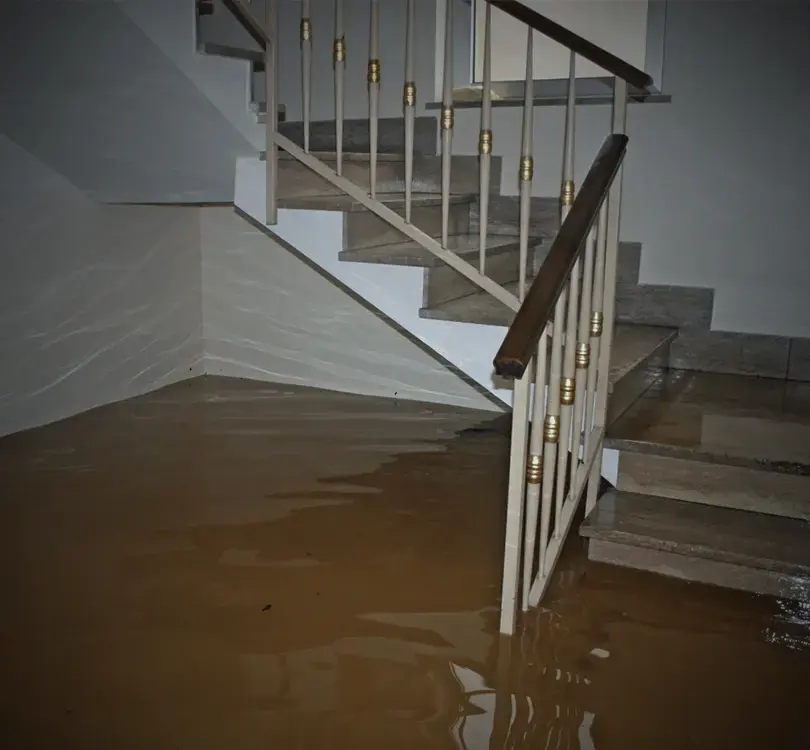
What to do first about basement flooding cleanup in O'Fallon
- Stay off the stairs if outlets are wet
Water near outlets, cords or a furnace can be energized. Cut power at the breaker only if the panel is dry.
- Stop the source
Check the sump pit, the water heater and the washer. Shut the main valve if a supply line is leaking.
- Photograph before moving anything
Timestamped photos of every wet wall and floor start the claim file.
- Lift what can be lifted
Move boxes, rugs and furniture legs off the wet floor.
- Call for extraction
Mold can start inside 24 to 48 hours, so drying should start right away.
What does basement flooding cleanup cost in O'Fallon, MO?
In O'Fallon, MO, basement flooding cleanup typically runs $2,500 to $12,000. A small clean-water loss caught early sits at the low end; a whole finished basement or Category 3 water costs more.
Part of the basement
- Clean water caught early
- Pad removed, carpet dried in place
- Daily moisture readings
Whole finished basement
- Flood cuts and insulation removal
- Several LGR dehumidifiers
- Slab and framing dried
Floor drain or floodwater
- Category 3 protocol
- Porous materials removed
- Containment and antimicrobial
These are typical ranges, not a quote. The drivers are the water category, the square footage, the material class and how fast drying started. For a closer planning number, try the water damage cost calculator.
How basement flooding cleanup is handled in O'Fallon, MO
Map the moisture
Meters and thermal imaging show how far water wicked into walls and under flooring.
Extract
Truck-mounted extraction pulls standing water from carpet, pad and the slab.
Remove and open
Wet pad comes out, and drywall is flood cut where it wicked water.
Dry and verify
Air movers and LGR dehumidifiers run until readings reach the drying goal.
Most O'Fallon houses built since the mid 1980s sit on a full poured-concrete basement, and a lot of those basements were finished later with carpet, drywall and a bedroom or two. That makes basement water the loss the drying team sees more than any other in St. Charles County.
Where the water comes from in an O'Fallon basement
The source decides the category of the water, and the category decides what can be dried and what has to go. The tech who does the walkthrough finds the source first.
- A sump pump that stops, sticks or loses power during a long spring rain
- Seepage through the cove joint where the wall meets the slab, pushed by saturated clay soil
- A window well that fills and pours through the basement window
- A floor drain that backs up when the sanitary sewer surcharges in a storm
- A water heater or washer on the same level that fails
Clean water from a supply line or a heater starts as Category 1. Groundwater and window-well water usually count as Category 2. Anything from a floor drain is treated as Category 3, and that job is handled under the sewage backup cleanup protocol.
How a finished basement is dried
The extraction crew pulls standing water with truck-mounted equipment, then lifts the carpet to pull the pad, which holds water like a sponge. Where drywall wicked water up from the floor, the mitigation team makes a flood cut above the wet line so air can reach the bottom plate and studs. Air movers and LGR dehumidifiers then run around the clock, and a basement slab often needs longer than the walls above it.
Trade fact: concrete gives up water slowly. A slab can read dry on the surface and still hold moisture that would cup new flooring, so the drying team checks it with a meter before anything goes back down.
After the water is out
Once the readings reach the drying goal, the basement is ready for repairs. If the water came from outside, the fix for next time is usually grading, gutters and the sump system; the sump pump failure page covers the pump side. The FloodSmart, the National Flood Insurance Program site explains how flood coverage differs from a homeowners policy, and the Missouri Department of Commerce and Insurance answers questions about Missouri claims.
Basement Flooding Cleanup questions in O'Fallon, MO
Can wet basement carpet be saved?
Often, when the water is clean and extraction starts early. The pad underneath is usually removed because it holds water and cannot be dried reliably. Carpet touched by floor drain or floodwater is removed.
How far up does the drywall have to be cut?
Most crews cut 12 to 24 inches above the highest wet reading, not the visible water line, because drywall wicks water higher than it looks.
Why does the basement smell musty after a flood?
Moisture trapped in pad, drywall and the slab. The smell fades once the materials reach the drying goal; covering it up without drying just hides the problem.
Is basement flooding covered by insurance in Missouri?
It depends on the source and the policy. A burst pipe is often treated differently from groundwater seepage or a sewer backup, which may need a separate endorsement. Coverage depends on your policy, so it is worth checking with your own insurer.
How long does a flooded basement take to dry?
A contained loss usually dries in three to five days after extraction. A concrete slab, hardwood or a large finished level can take longer.
Should I run fans and a household dehumidifier myself?
It helps a little, but household units cannot keep up with a soaked basement. Moving air without enough dehumidification can push humidity into the rest of the house.
Basement flooding cleanup across O'Fallon, MO
The O'Fallon restoration crew handles basement flooding cleanup in Old Town, WingHaven, Copperfield and the Highway K, Highway N and Bryan Road corridors, ZIP codes 63366 and 63368, with St. Peters, Dardenne Prairie, Lake Saint Louis, Wentzville, Cottleville, St. Paul, Weldon Spring and St. Charles close by.
Water damage in O'Fallon right now?
The restoration team extracts standing water, dries the structure to the IICRC S500 standard and documents every step for your insurance claim.