Structural Drying & Dehumidification in O'Fallon, MO
Surface dry is not the same as structurally dry. The drying team sizes air movers and LGR dehumidifiers to each room and keeps them running until the framing, subfloor and slab read dry.
(888) 603-7319Get the structure dried to standard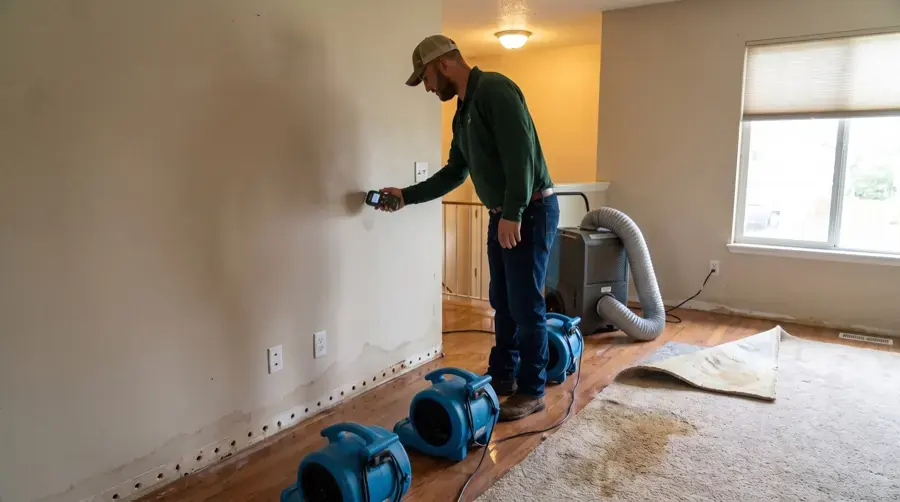
What to do first about structural drying in O'Fallon
- Get the standing water out first
Drying equipment works only after extraction.
- Keep the house closed
Windows closed and the HVAC set as the drying team suggests.
- Leave the equipment running
Turning it off at night stalls the drying.
- Keep a path clear
Crews take readings in the same spots every day.
What does structural drying cost in O'Fallon, MO?
In O'Fallon, MO, structural drying typically runs $1,000 to $8,000, driven by how many rooms need equipment, the class of the loss and how many days the equipment runs.
One or two rooms
- A few air movers
- One dehumidifier
- Three to five days
Basement or level
- Multiple LGR units
- Wall and floor drying
- Daily logs
Class 4 materials
- Desiccant drying
- Hardwood or slab drying
- Longer equipment days
These are typical ranges, not a quote. The drivers are the water category, the square footage, the material class and how fast drying started. For a closer planning number, try the water damage cost calculator.
How structural drying is handled in O'Fallon, MO
Map and classify
Meters and thermal imaging set the class of the loss.
Place equipment
Air movers and dehumidifiers are sized to each room.
Read daily
Moisture and psychrometric readings are logged every day.
Verify dry
Equipment comes out when readings match the dry reference.
Once the standing water is gone, the real work is pulling moisture out of the materials that soaked it up. Structural drying is a controlled process: the drying team measures, sets equipment for the conditions in that room and checks every day until the readings say the job is done.
How a drying plan is set
The tech who does the walkthrough maps the moisture with pinless and pin meters and thermal imaging, then classifies the loss. Class 1 is a small area with little absorbed water; Class 4 means dense materials like hardwood, plaster or a concrete slab that give up water slowly.
- Air movers are placed to move air across wet surfaces at the right rate
- LGR dehumidifiers pull the evaporated water out of the air, even in a cool basement
- Desiccant dehumidifiers handle Class 4 materials and very cold spaces
- Wall cavity and floor drying systems push dry air into closed spaces
Daily readings and the drying goal
Every day the drying team records the moisture content of the wet materials and the temperature and humidity in the room, called psychrometric readings. The goal is set by measuring a dry reference material of the same kind in an unaffected part of the house. The equipment comes out when the wet material reads within 2 to 4 points of that reference, not when a set number of days has passed.
Trade fact: humid St. Charles County summers make open windows a mistake during drying. The dehumidifiers control the air better when the house is closed up.
Why the drying log matters
The daily log shows the adjuster that the structure was dried to the standard and when it reached the goal. It is also the proof that reconstruction can start without trapping moisture. The EPA moisture and mold guidance explains why drying within 24 to 48 hours matters, and the University of Missouri Extension covers home moisture basics. For the first step, see water extraction.
Structural Drying and Dehumidification questions in O'Fallon, MO
Why does drying take several days?
Water has to move from inside the materials to the surface, evaporate and be removed from the air. Dense materials release it slowly.
Can I turn the equipment off at night?
It is best not to. Stopping the equipment lets humidity rise and slows the drying.
What is an LGR dehumidifier?
A low grain refrigerant dehumidifier that keeps removing water even when the air is already fairly dry or cool, like in a basement.
What does Class 4 mean?
A loss involving dense materials such as hardwood, plaster or concrete that hold water tightly and need special drying methods.
How do I know the house is really dry?
The drying log shows the wet materials reached the dry reference reading. Ask to see it before repairs start.
Why are the air movers so loud?
They move a lot of air across the wet surfaces. The noise is part of the process and ends when the drying goal is reached.
Structural drying across O'Fallon, MO
The O'Fallon restoration crew handles structural drying in Old Town, WingHaven, Copperfield and the Highway K, Highway N and Bryan Road corridors, ZIP codes 63366 and 63368, with St. Peters, Dardenne Prairie, Lake Saint Louis, Wentzville, Cottleville, St. Paul, Weldon Spring and St. Charles close by.
Water damage in O'Fallon right now?
The restoration team extracts standing water, dries the structure to the IICRC S500 standard and documents every step for your insurance claim.